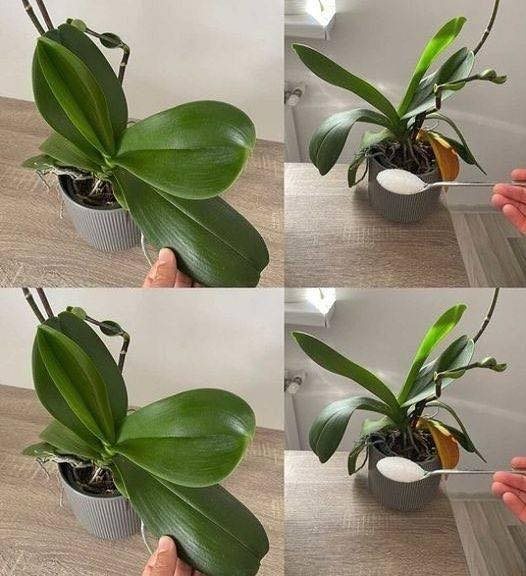
There’s a popular claim online that “just 1 tablespoon” of a certain ingredient will make orchids bloom nonstop.
Some of these viral tricks work, some are harmless, and some can actually damage orchids.
Here is the real safe, effective version of the idea — and the ingredient that actually helps orchids bloom:
🌸 The Safe, Powerful ‘1 Tablespoon’ Orchid Fertilizer
✅ 1 tablespoon of Epsom salt (magnesium sulfate) per gallon of water
Why it works
Orchids—especially Phalaenopsis—use magnesium to:
- Boost chlorophyll production
- Improve leaf health
- Increase bloom spikes
- Produce more vibrant flowers
A mild magnesium supplement can make orchids bloom more consistently when used correctly.
🌱 How to Use It (Safe Method)
1. Mix the solution
- Add 1 tablespoon Epsom salt to 1 gallon (4 liters) of water.
- Stir until dissolved.
2. Apply once every 4–6 weeks
- Water your orchid with this solution after you’ve already moistened the roots with plain water.
(This prevents salt burn.)
3. Do not replace normal fertilizer
Use your regular orchid fertilizer (balanced 20-20-20 or orchid-specific) every 2–3 weeks.
Magnesium is a supplement, not the main fertilizer.
🚫 Avoid These Viral “Miracle Orchid Fertilizers”
These can harm roots or permanently stunt the plant:
- Milk
- Rice water (ferments, causes rot)
- Sugar water (grows bacteria)
- Coffee grounds (too acidic, attracts fungus gnats)
- Baking soda (damages roots)
Stick to what orchids actually need:
nitrogen, phosphorus, potassium, calcium, magnesium, and steady moisture.
🌸 Extra Tips for Nonstop Blooming
✔ Bright, indirect light
Orchids need 12–14 hours of bright filtered light.
✔ Temperature drop
A 10°F (5–6°C) nighttime drop can trigger a bloom spike.
✔ Water properly
Water when the medium is nearly dry—usually every 7–10 days.
✔ Repot every 1–2 years
Old bark breaks down → suffocates roots → no blooms.
🌟 If You Want
I can give you:
- A bloom-boosting care schedule
- A homemade orchid fertilizer recipe
- A guide to reviving non-blooming orchids
- Care tips for specific orchids (Phalaenopsis, Oncidium, Cattleya, etc.)
Just tell me what type of orchid you have!
